Bitcoin Mining Hosting Costs: How to Calculate Your Real $/kWh Rate
Compare Bitcoin mining hosting offers by calculating the total economic cost per actual kWh consumed, including PUE, setup fees, prepayments, downtime rules, power measurement and other charges—not just the advertised electricity rate.
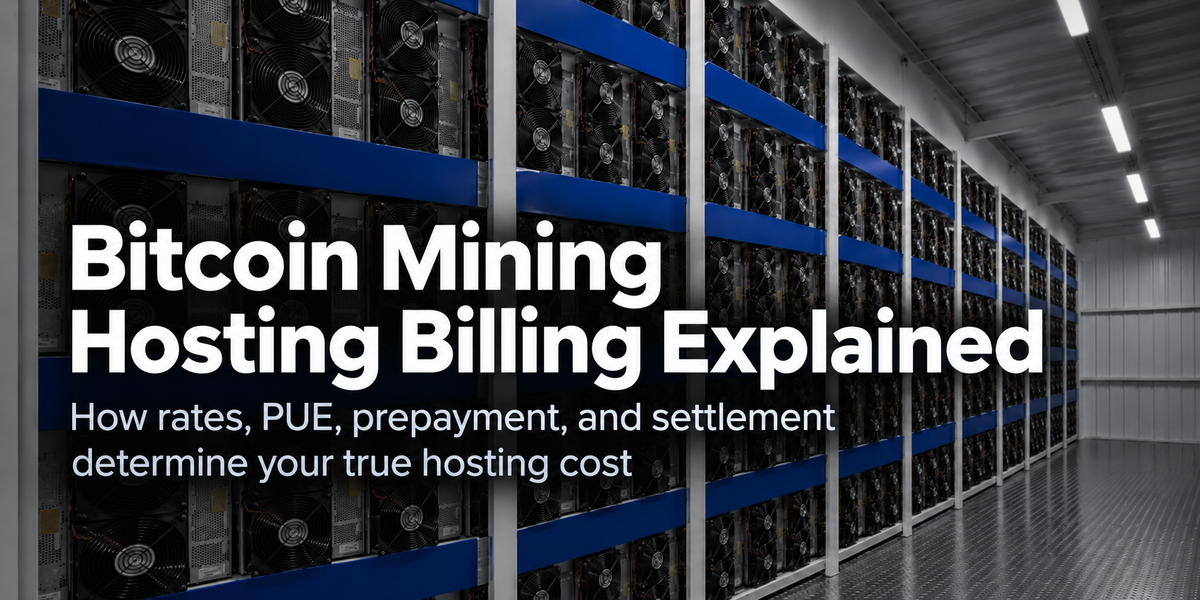
The advertised electricity rate is usually the first number customers look at when comparing Bitcoin mining hosting offers. It is also one of the easiest numbers to misunderstand.
A host may advertise $0.070/kWh, but PUE, setup fees, long-term prepayments, downtime rules, power-measurement methods and miscellaneous charges can make the real cost materially higher.
The advertised hosting rate is not necessarily the customer's real hosting rate.
In this guide, we show how to convert each of these contract terms into an effective $/kWh, so different hosting offers can be compared on an apples-to-apples basis. We also show why a $0.070/kWh rate can become approximately $0.0935/kWh, and why an apparently cheap $0.045/kWh seven-year prepaid offer can normalize to around $0.079/kWh once the cost of tying up capital is considered.
For consistency, most calculations use the same example: an Antminer S21 XP 270T consuming 3.645 kW, a three-year hosting contract, a $0.070/kWh advertised rate, and a 20% annual required return on upfront capital.
| Standard assumption | Value |
|---|---|
| Miner | Antminer S21 XP 270T |
| Power consumption | 3.645 kW |
| Annual consumption at 100% uptime | 31,930 kWh |
| Standard hosting contract | 3 years |
| Standard advertised rate | $0.070/kWh |
| Required return on upfront capital | 20% annually |
The 20% required return is an assumption used in this guide, not an industry standard. The appropriate hurdle rate depends on the risk of the hosting provider and project.
For this article:
Effective hosting rate = total economic hosting cost ÷ actual kWh consumed by the miner
That is the number we believe customers should ultimately compare.
Why the real hosting rate matters
Electricity usually becomes much more expensive than the mining machine itself over the miner's useful life.
An S21 XP consuming 3.645 kW at $0.070/kWh and 1.05 PUE costs approximately:
3.645 kW × 8,760 hours × $0.070 × 1.05 = $2,347 per year
Over five years, that is approximately $11,734 in hosting costs.
Using an illustrative machine purchase price of $2,970, five years of hosting would cost almost four times the purchase price of the miner.
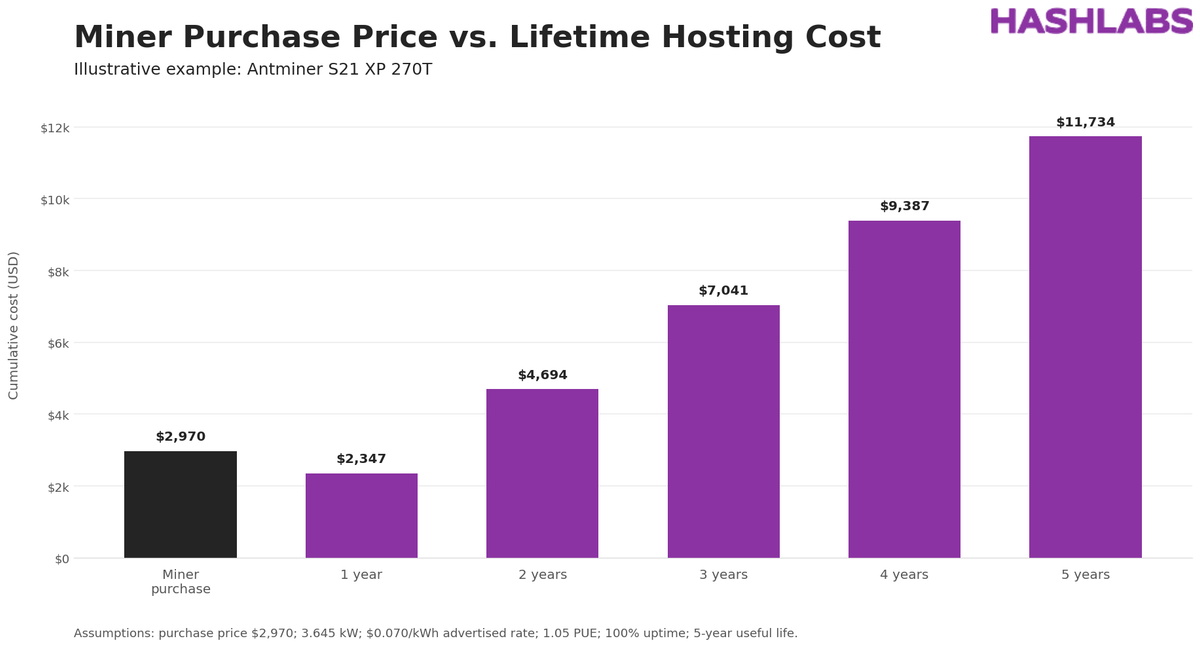
Small differences in the real hosting rate therefore have a large effect on lifetime mining economics.
You can model different assumptions using the Hashlabs Bitcoin Mining Calculator.
How does PUE affect the real hosting rate?
PUE, or Power Usage Effectiveness, accounts for electricity consumed by the facility in addition to the electricity consumed directly by the miners.
Cooling systems, fans, pumps, transformers, networking equipment and other infrastructure require power.
In Hashlabs' experience, every Bitcoin mining hosting provider we have encountered recovers PUE or equivalent facility electricity consumption from the customer in one form or another.
That is normal and economically reasonable. The miner indirectly requires this electricity to operate. The important question is how much is being added and whether the customer understands it.
With a $0.070/kWh rate and 1.05 PUE:
$0.070 × 1.05 = $0.0735/kWh
So 1.05 PUE adds:
$0.0035/kWh, or 5%, to the headline rate.
At 1.25 PUE, the same $0.070 rate becomes:
$0.0875/kWh
Across Hashlabs' current hosting sites, PUE is generally around 1.03–1.07.
Despite its financial importance, almost no Hashlabs hosting customer has asked us:
What is the site's actual PUE, and is it added to my bill?
That should be one of the first questions asked when comparing hosting facilities.
For more detail, see our practical guide to PUE in Bitcoin mining.
How much does a setup fee add to the real rate?
Some hosting providers charge an upfront setup fee in addition to the electricity rate.
For this example, assume a $200 setup fee per miner.
For an S21 XP using 3.645 kW, $200 per miner is equivalent to approximately $55,000 per MW. Larger deployments are often quoted setup fees per MW rather than per miner.
Because the money is paid upfront, the setup fee should be amortized over the expected hosting period and adjusted for the customer's cost of capital.
Using our standard three-year contract and a 20% annual required return, the $200 fee adds approximately:
$0.0027/kWh
The isolated effective rate therefore becomes:
$0.0700 + $0.0027 = $0.0727/kWh
This calculation assumes no PUE, downtime or other charges.
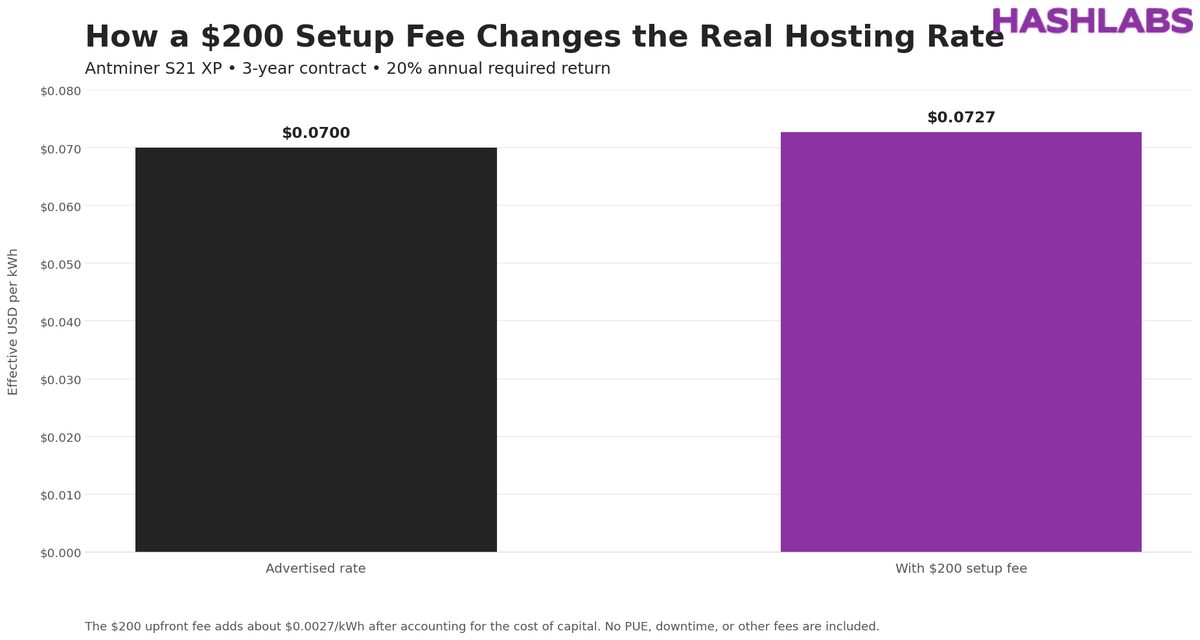
A $200 setup fee turns a $0.070/kWh three-year hosting rate into approximately $0.0727/kWh when the upfront capital is valued at a 20% required return.
The larger the setup fee, the more important it becomes to have a sufficiently long and reliable contract over which to amortize it.
Hashlabs also charges setup fees in some larger, longer-term deployments. Where we do, they are clearly disclosed and negotiated as part of the commercial structure.
How should seven years of prepaid hosting be compared?
One month of prepaid hosting is common. Electricity bills are large, and hosting providers understandably do not want customers consuming power before paying.
Paying years of hosting upfront is very different.
A multi-year prepaid hosting rate cannot be compared directly with a normal hosting rate. The cost of tying up the customer's capital must be included.
We recently reviewed a U.S. hosting offer advertising approximately $0.045/kWh if seven years of hosting are prepaid.
The provider marketed this as a 30% discount.
That tells us the implied normal rate without the seven-year prepayment:
$0.045 ÷ 0.70 = approximately $0.0643/kWh
At first glance, $0.045/kWh appears extremely cheap.
But the customer must transfer seven years of hosting payments on day one.
Using a 20% annual required return on capital, the $0.045/kWh seven-year prepaid rate normalizes to approximately:
$0.0791/kWh
The comparison therefore looks like this:
| Structure | Effective comparison rate |
|---|---|
| Advertised 7-year prepaid rate | $0.0450/kWh |
| Implied normal no-prepayment rate | $0.0643/kWh |
| 7-year prepaid rate normalized at 20% required return | $0.0791/kWh |
| Standard monthly example used in this guide | $0.0700/kWh |
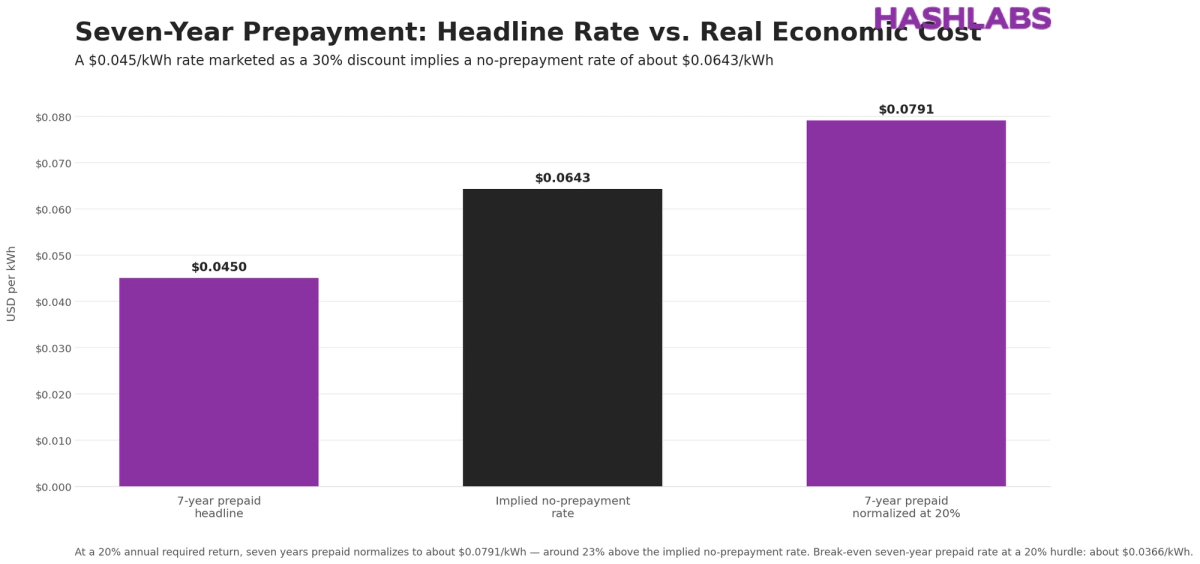
The result is striking.
A $0.045/kWh seven-year prepaid rate can be economically equivalent to approximately $0.0791/kWh paid over time when capital is valued at a 20% annual required return.
That normalized rate is approximately 23% higher than the provider's implied $0.0643/kWh normal rate, and around 13% higher than the $0.070/kWh standard rate used throughout this guide.
At a 20% required return, the seven-year prepaid rate would need to be approximately:
$0.0366/kWh
to have the same economic value as paying the implied $0.0643/kWh normal rate over time.
And this calculation only accounts for the time value of money.
Seven years creates substantial additional risk. The miner may become obsolete. The customer may want to relocate. The site's power arrangement may change. The facility may stop operating. The hosting provider itself may cease to exist. Recovering unused prepaid balances can also become difficult.
Hashlabs has itself been a hosting customer in situations where a hosting arrangement ended while the provider still held unused prepaid funds and recovering those funds became a problem.
The longer the hosting prepayment, the more the customer becomes a creditor of the hosting provider.
Do you pay for actual kWh or a fixed amount of power?
This is one of the most important questions a hosting customer can ask.
Do I pay for the electricity my miner actually consumes, or am I billed a fixed kW amount for every hour the miner is running?
These billing methods can produce very different results.
Suppose an S21 XP has a nominal consumption of 3.645 kW but actually consumes 10% less because of firmware, underclocking or other operating settings.
Actual consumption would be:
3.645 × 90% = approximately 3.281 kW
If the customer is billed actual consumption, the bill falls with the miner's power use.
If the hosting provider continues billing the full 3.645 kW for every operating hour, the customer receives none of that saving.
The nominal $0.070 rate then becomes:
$0.070 ÷ 0.90 = $0.0778 per actual kWh consumed
If actual miner power falls by 10% but billed power does not, a $0.070/kWh hosting rate becomes approximately $0.0778 per actual kWh consumed.
We generally consider fixed-power billing unfavorable to hosting customers.
It can also create a poor incentive structure. If the hosting provider pays its own electricity supplier based on actual consumption but bills the customer based on a fixed power level, the host earns a larger spread whenever the miner consumes less electricity.
In principle, that can give the host an incentive to underclock miners, operate them below maximum capacity or otherwise reduce actual power consumption while continuing to bill the higher fixed amount.
That does not mean every provider using fixed-power billing does this. It means the billing structure creates the incentive.
Physical smart metering is the most accurate measurement method. Where individual miner meters are impractical, miner-management platforms such as Hiveon or Foreman can provide miner-level consumption data.
Hashlabs uses Hiveon at most of its sites and has found its miner-level power data sufficiently precise for billing reconciliation.
Does every hour of downtime reduce your bill?
Not necessarily.
It is surprisingly common for hosting contracts to allow the provider a certain amount of downtime before customer credits begin.
Hashlabs has encountered this structure even among large hosting providers. A typical example may allow around 5% downtime before credits are issued.
That means a facility could operate at 95% uptime while the customer is still billed as though the machine operated continuously.
If the customer pays for 100% of the period but receives only 95% uptime:
$0.070 ÷ 0.95 = $0.0737/kWh actually consumed
So a 5% uncredited downtime allowance turns an isolated $0.070 rate into approximately:
$0.0737/kWh
Customers should therefore always ask:
Is every hour of downtime credited, or does the host allow itself some downtime before issuing a credit?
There is also an important distinction between downtime and power measurement.
Crediting downtime is not the same as billing actual power consumption.
A provider can credit every hour that a miner is offline while still billing a fixed assumed power level whenever the machine is running.
Both terms need to be checked separately.
How much do miscellaneous hosting fees add?
Hosting agreements can contain charges beyond electricity and setup.
These may include wire or payment fees, administration charges, monitoring fees, firmware charges, repair-related fees and deracking fees when machines leave the facility.
Assume recurring miscellaneous fees of $10 per month per miner.
That is $120 per year.
An S21 XP consumes approximately 31,930 kWh per year at 100% uptime, so:
$120 ÷ 31,930 = approximately $0.0038/kWh
The isolated effective rate becomes:
$0.0700 + $0.0038 = $0.0738/kWh
We do not apply an upfront cost-of-capital adjustment here because these fees are paid during the hosting relationship or when equipment leaves the site rather than years in advance.
The customer should understand every fee the provider is contractually entitled to charge before signing the hosting agreement.
See our guide to 9 costly Bitcoin mining hosting mistakes and how to avoid them.
How much can each term change a $0.070/kWh rate?
The previous examples intentionally isolated each variable.
| Isolated contract term | Effective rate |
|---|---|
| Advertised rate | $0.0700/kWh |
| 1.05 PUE | $0.0735/kWh |
| $200 setup fee, 3 years, 20% required return | $0.0727/kWh |
| 5% downtime without credit | $0.0737/kWh |
| $10/month miscellaneous fees | $0.0738/kWh |
| Actual power 10% below fixed billed power | $0.0778/kWh |
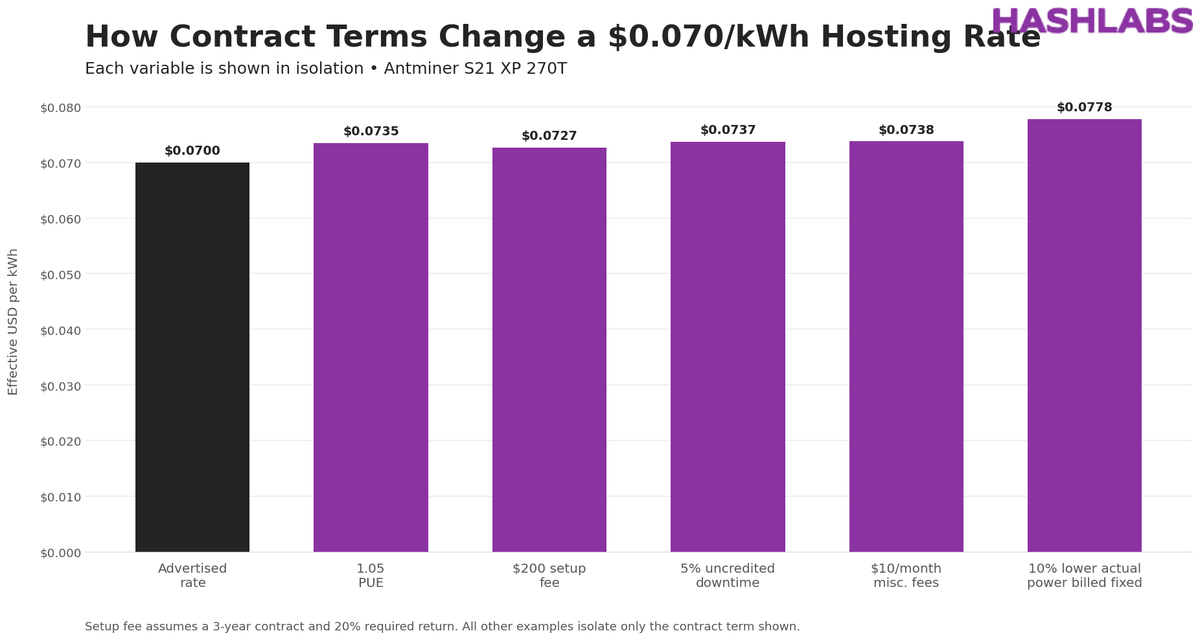
Two hosting providers advertising the same $/kWh rate can have materially different real hosting costs.
How can $0.070/kWh become approximately $0.0935/kWh?
So far, each factor has been considered separately.
In a real contract, several may apply at the same time.
Consider an illustrative S21 XP arrangement with a $0.070/kWh headline rate, 1.05 PUE, 5% downtime before credits, actual consumption 10% below the fixed power amount being billed, a $200 upfront setup fee on a three-year agreement, a 20% required return on that upfront capital, and $10/month in miscellaneous charges.
The cumulative rate changes approximately as follows:
| Cost layer | Cumulative effective rate |
|---|---|
| Advertised rate | $0.0700/kWh |
| After 1.05 PUE | $0.0735/kWh |
| After 5% uncredited downtime | $0.0774/kWh |
| After actual power is 10% below billed power | $0.0860/kWh |
| After economic cost of setup fee | $0.0891/kWh |
| After miscellaneous fees | $0.0935/kWh |
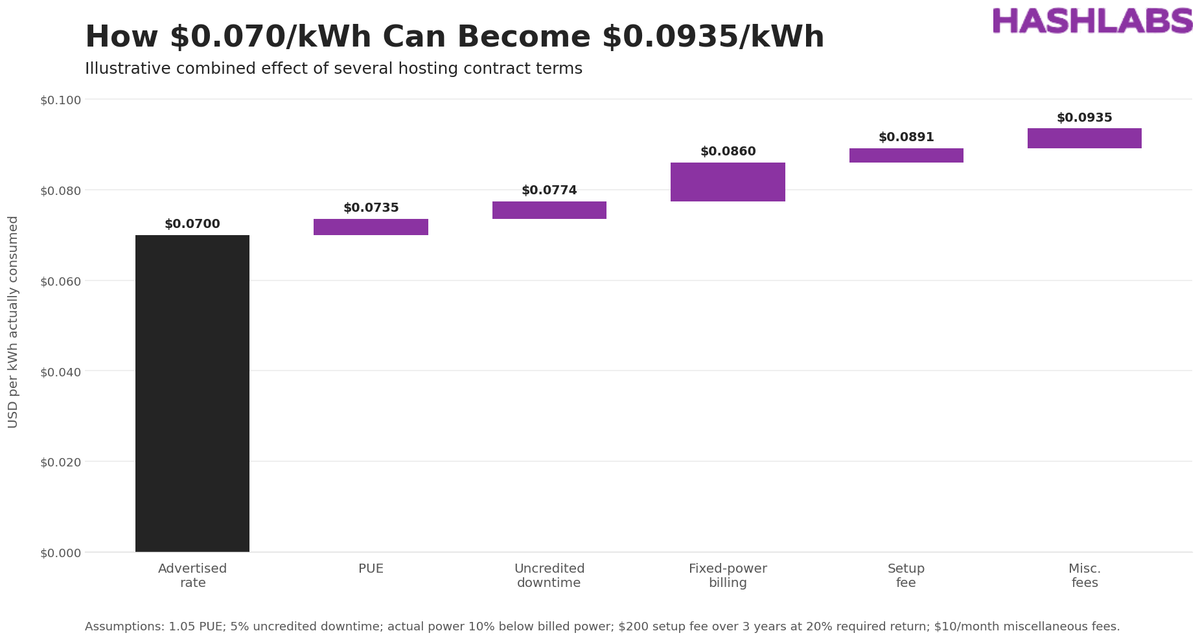
Under these assumptions:
A $0.070/kWh advertised hosting rate becomes approximately $0.0935 for every kWh the miner actually consumes.
That is approximately 34% above the advertised rate.
This is an illustrative combination of contract terms. It is not a claim that this exact combination is typical of any particular hosting provider.
Its purpose is to show why a headline electricity rate alone is not enough to compare hosting offers.
How does Hashlabs bill hosting?
Hashlabs' methodology is designed around a simple principle:
With Hashlabs, the customer ultimately pays for the electricity the miners actually consume, plus the site's PUE.
The process is:
- Prepayment. We invoice an estimated monthly hosting amount in advance based on expected consumption.
- Actual consumption. After the month, we use recorded miner-level electricity consumption rather than simply charging a fixed nameplate power amount for every hour the miner was online.
- Settlement. We reconcile the prepayment against the actual electricity consumed and add the site's PUE. If consumption was lower because of downtime or lower power draw, the customer's final cost falls. If consumption was higher, the settlement increases.
Hashlabs does not give itself a 5% downtime allowance before consumption reductions begin to benefit the customer.
In Finland, where uptime has historically been close to 100% and PUE approximately 1.03, settlements often increase slightly because hydro-cooled WhatsMiner units can consume somewhat more than their stated power.
In Brazil, uptime has been approximately 98% and PUE around 1.05, meaning the PUE addition can outweigh modest downtime.
In Ethiopia, periods of poor uptime have generally outweighed the approximately 1.05 PUE, so customers have usually received credits.
The purpose of settlement is not to guarantee that the adjustment goes in either direction.
It is to make the final invoice reflect the electricity that was actually consumed.
Bitcoin mining hosting rate checklist
Before signing a hosting agreement, ask:
- What is the advertised $/kWh rate, and what other costs must be added before I arrive at the real rate?
- Is PUE added to my bill, and what has the site's actual historical PUE been?
- Is there a setup fee, and what does that fee add to my effective $/kWh after considering the contract length and cost of capital?
- How much hosting must I prepay? If I am paying several years upfront, what is the capital-adjusted equivalent rate compared with paying normally over time?
- Do I pay for the kWh my miners actually consume, or a fixed kW amount for every hour the machines are considered online?
- If my miners consume less power because of firmware, underclocking or operating conditions, does my bill decrease accordingly?
- Is every hour of downtime reflected in my bill, or does the host allow itself a downtime threshold before issuing credits?
- What recurring charges can be added beyond the electricity rate, such as administration, monitoring, payment or repair-related fees?
- What charges apply when my machines leave the facility, including deracking or other exit fees?
- If hosting ends while the provider still holds prepaid funds, when and how is the unused balance returned?
- After normalizing all of these terms, what is my total economic cost per kWh actually consumed?
Ask the hosting provider to show you exactly how the advertised $/kWh rate becomes your final invoice.
For broader hosting due diligence, see our guide to the 9 factors to evaluate when choosing a Bitcoin mining hosting provider.
Conclusion
The cheapest advertised Bitcoin mining hosting rate is not necessarily the cheapest hosting offer.
A $0.070/kWh rate can become $0.0735 after PUE, $0.0727 after a setup fee, $0.0737 after uncredited downtime, $0.0738 after modest miscellaneous fees, or $0.0778 if the customer is billed fixed power while the miner actually consumes 10% less electricity.
A $0.045/kWh seven-year prepaid rate can normalize to approximately $0.0791/kWh when the cost of tying up capital is valued at a 20% annual required return.
And when several cost layers apply together, an advertised $0.070/kWh can become approximately $0.0935/kWh actually consumed.
The right question is therefore not:
What hosting rate is advertised?
It is:
What is the total economic cost per kWh my miners actually consume?
You can see Hashlabs' current hosting availability and pricing on our Bitcoin mining hosting page.