9 Costly Bitcoin Mining Hosting Mistakes — and How to Avoid Them
The costliest Bitcoin mining hosting mistakes usually result from weak due diligence, unclear pricing, poor contract protections, operational weaknesses, and counterparty risk. Verify the facility, economics, operator, and legal terms before sending funds or mining equipment.
Our team has operated Bitcoin mining hosting since 2021. During that time, we have watched investors make the same costly mistakes repeatedly—some while working with us, and many while working with other operators.
These mistakes are not limited to first-time investors. Several are difficult to recognise unless you work inside the mining industry every day.
This article explains the nine most common mistakes, what to look for, and which questions to ask before sending money to a hosting provider. We have also explained where Hashlabs stands on each issue, including areas where no operator is perfect.
The mining hosting industry has earned its trust problem. The sensible response is careful scrutiny.
Read this before sending money to any operator—including us.
The nine mistakes at a glance
Use this list before signing any mining hosting agreement:
- Not doing enough due diligence on the operator
- Ignoring country and regulatory risk
- Not understanding the operator’s client systems and invoicing
- Not accounting for hidden costs
- Underestimating repair needs and logistics
- Paying large upfront costs without adequate security
- Not considering your exit strategy
- Buying at the wrong time in the market cycle
- Ignoring corporate structure and tax before investing
Mistake 1: Not doing enough due diligence on the operator
This is the single most important factor in your entire investment.
The operator stands between you and your machines. You may be sending them tens or hundreds of thousands of dollars, and trusting them to purchase, install, operate and protect your equipment for several years.
The mining industry has a real history of operators disappearing with client funds, running machines carelessly, mismanaging facilities or simply going out of business.
Counterparty risk is one of the largest risks in Bitcoin mining hosting, yet many investors underestimate it. Most operators will not emphasise this risk when selling to you. We do, because we believe an informed investor is more likely to become a satisfied long-term client.
Before sending money, you should:
- Check the company’s Trustpilot and Google reviews, and read the individual reviews rather than looking only at the rating.
- Search for the company on Google, Reddit, forums and social media.
- Research the people behind the business. Are they real, findable and credible?
- Ask the company directly about its history, ownership and operating track record.
- Ask whether you can speak with an existing or former client.
- Request evidence that your machines exist and are connected after deployment.
- Trust your judgement. After completing your research, does the company feel solid?
Where Hashlabs stands
We encourage prospective clients to research our company and the people behind it.
What an operator says about itself matters less than what you are able to verify independently. Apply the same level of scrutiny to Hashlabs that you would apply to any other operator.
Mistake 2: Ignoring country and regulatory risk
Location affects your mining investment in more ways than electricity price alone.
Every country where your machines operate carries some level of political, regulatory, legal and operational risk.
Developing markets often offer cheaper electricity, but that lower price can come with significantly greater uncertainty. Large mining operations in countries including Kazakhstan, Paraguay and Ethiopia have faced shutdowns, curtailments, regulatory changes, payment restrictions or operational failures.
Hashlabs has operated in some of these markets. Our experience is that the cheapest electricity rate is not always worth the additional risk.
Developed markets are not risk-free either.
Some European governments, Nordic countries, Canadian provinces and US states have proposed or implemented policies that are unfavourable to Bitcoin mining. Tax rules, energy regulation, grid-access rules and public policy can all change during the life of an investment.
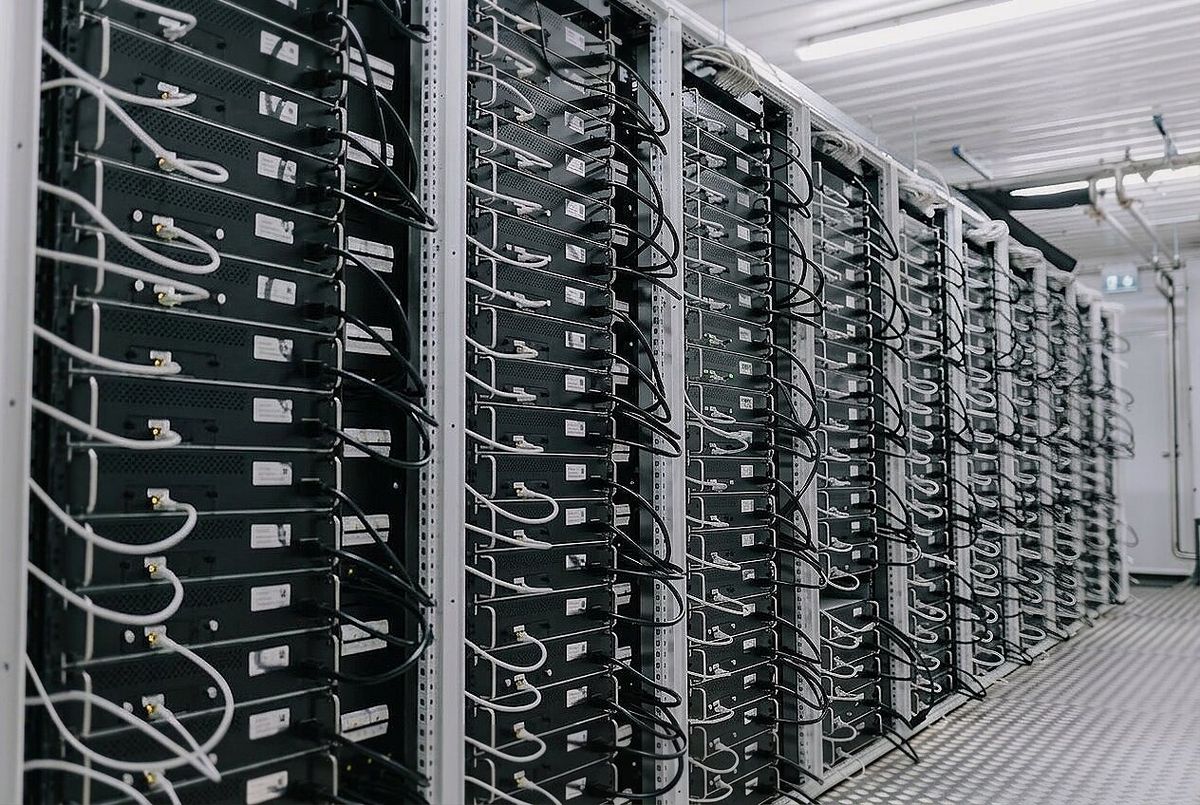
The United States generally offers a mature mining ecosystem, broad access to infrastructure and a relatively business-friendly environment in several states. However, conditions still vary materially by state, utility and local jurisdiction.
Before choosing a location, ask the operator:
- What is the current regulatory environment?
- Has the facility experienced power restrictions or curtailments?
- Could the government or utility change the electricity arrangement?
- Who owns the facility and the power agreement?
- Are the machines legally imported and properly registered?
- Can the machines be exported if you decide to move them?
- What happens if the site is forced to close?
An operator that claims there is no regulatory risk is either uninformed or not being fully transparent.
Where Hashlabs stands
We prefer operating in stable jurisdictions and aim to structure our facilities in ways that reduce regulatory and operational risk.
Risk can often be reduced by using proper contracts, complying with local rules, maintaining accurate documentation and choosing credible partners. It cannot be eliminated entirely.
We aim to be transparent with clients about the trade-off between cheaper hosting and greater jurisdictional risk.
Mistake 3: Not understanding the operator’s client systems and invoicing
A mining investment should be managed with the same level of visibility you would expect from any professional financial or infrastructure service.
Some operators still manage customers through scattered spreadsheets, informal messages and manually prepared invoices. Clients may have no reliable way to see their machines, contracts, payments, repairs or support history.
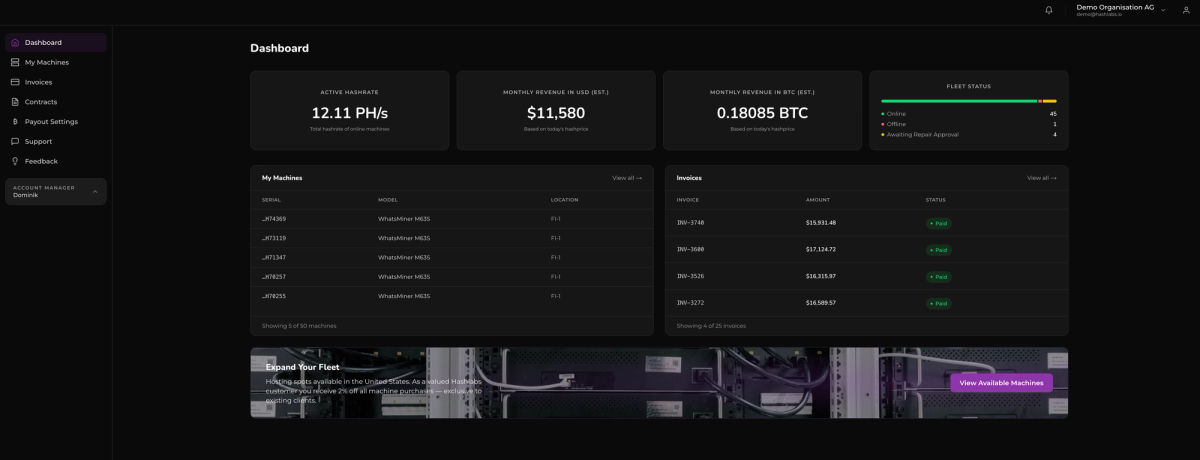
Before signing, ask to see the client experience in practice.
Can you:
- View your machines and their current status?
- Monitor hashrate and performance?
- Access contracts and invoices?
- See a per-machine billing breakdown?
- Submit and track support requests?
- Review repair history?
- Verify which machines belong to you?
A professional-looking dashboard does not guarantee good operations, but the absence of organised systems should be treated as a warning sign.
Understand the billing model before you sign
Invoicing is one of the most important parts of a hosting arrangement.
Many investors look at the advertised hosting rate and assume they understand what they will pay. Often, they do not.
Ask:
- How is electricity consumption measured?
- Are you billed based on actual consumption or theoretical machine capacity?
- What happens when a machine is offline?
- How is downtime treated?
- Are credits applied automatically?
- Is auxiliary power included?
- What documentation will you receive each month?
- Can you reconcile the invoice against machine-level data?
Billing errors can occur at any operator, including Hashlabs. The difference is whether you receive enough information to identify and correct them.
Reviewing invoices is an ongoing responsibility. Make sure the operator gives you the information required to do it properly.
Where Hashlabs stands
Hashlabs provides clients with access to a dedicated portal where they can view machines, performance, invoices, contracts and support requests.
Our invoices include machine-level information, and our billing model is based on the power actually consumed by the machines rather than a fixed theoretical uptime assumption.
Mistake 4: Not accounting for hidden costs
The advertised hosting rate is rarely the full economic cost.
Operators can structure fees in different ways, and the difference between the headline rate and what you actually pay can become significant over time.
The uptime guarantee trap
Some operators advertise a “95% uptime guarantee”.
That may sound reassuring, but you need to read the underlying terms carefully.
In many cases, the operator only provides a credit when uptime falls below 95%. If your machines achieve exactly 95% uptime, you may still be billed as though they operated for the full period.
For example, if the advertised rate is $0.070 per kWh but you pay for 100% of the month while receiving only 95% effective uptime, the economic rate is closer to $0.0737 per productive kWh.
Across many machines and several years, that difference becomes meaningful.
A clearer billing model charges for the electricity actually consumed by the machines.
Auxiliary power and PUE
Mining facilities consume power beyond the machines themselves.
Electricity may also be used for:
- Cooling
- Fans and pumps
- Lighting
- Networking equipment
- Transformers
- Site infrastructure
This is commonly measured using Power Usage Effectiveness, or PUE.
Auxiliary consumption is normal, but it should be explained clearly. Ask the operator:
- What is the facility’s expected PUE?
- Is auxiliary power included in the advertised rate?
- Is it charged separately?
- Is the figure fixed or based on actual usage?
- Can it vary by season?
Other potential fees
Also ask about:
- Setup fees
- Installation fees
- Deposits
- Administrative fees
- Repair handling fees
- Withdrawal fees
- Pool-management fees
- Shipping fees
- Customs costs
- Removal or termination fees
Before signing, request a complete list of every fee you may be charged.
You can also review the current-condition estimates on individual Hashlabs miner pages to see how electricity cost and machine efficiency affect monthly revenue and gross profit.
Where Hashlabs stands
Our facilities generally operate with relatively low auxiliary power consumption, although the exact figure varies by site and operating conditions.
We bill clients based on the electricity their machines consume rather than assuming a fixed level of uptime.
We aim to keep additional fees limited and clearly documented. Investors should nevertheless ask the same questions of Hashlabs that they ask of every other operator.
Mistake 5: Underestimating repair needs and logistics
Bitcoin mining machines are not ordinary consumer electronics.
They run continuously, at high temperatures and under heavy electrical load. Fans, power supplies, control boards and hashboards can all fail.
It is not a question of whether machines will eventually require maintenance. The important question is what happens when they do.
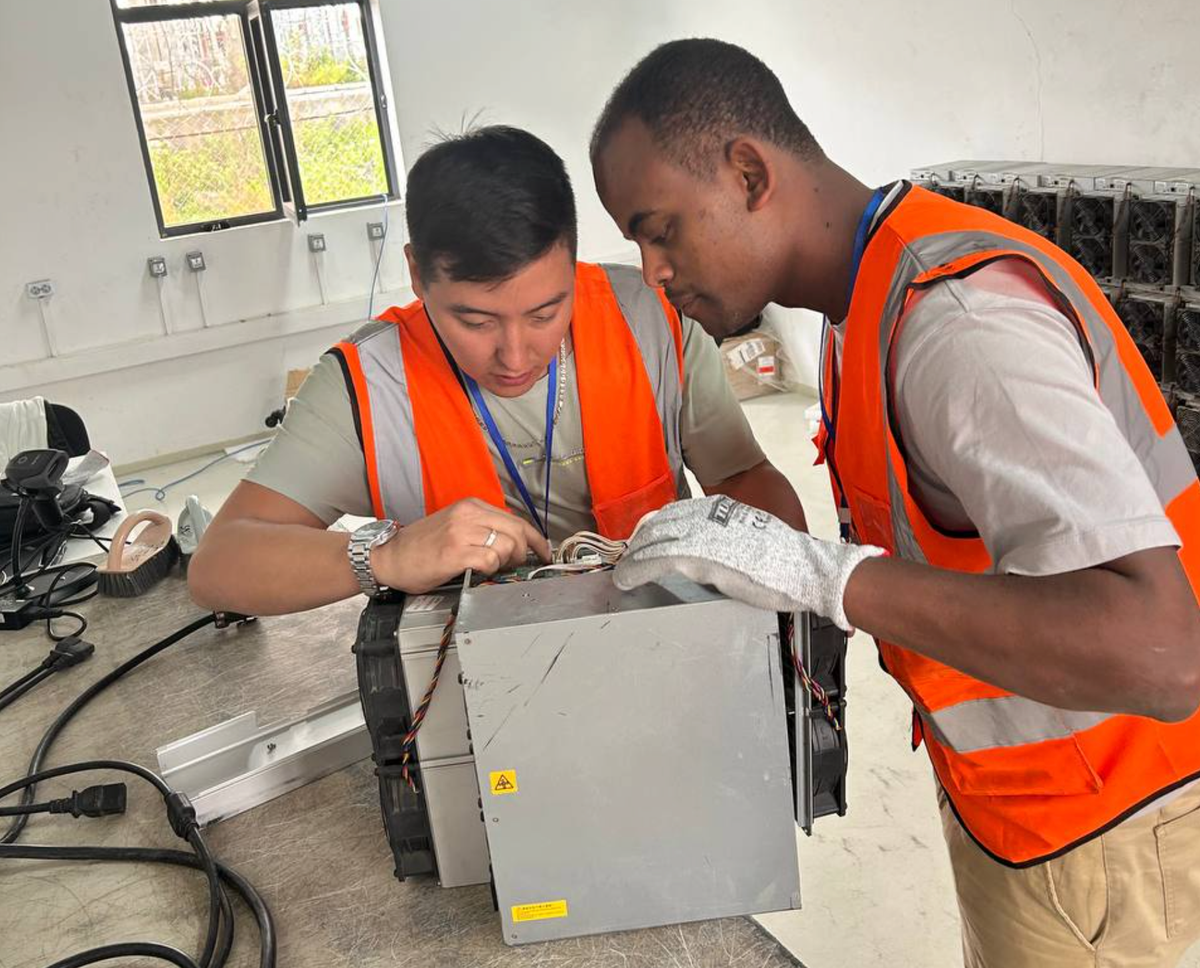
Before investing, understand:
- Who diagnoses failed machines?
- Is diagnosis performed on-site?
- Are spare parts available locally?
- Is there a certified repair centre nearby?
- How long do repairs typically take?
- Who pays for shipping?
- Do you approve repairs before work begins?
- What happens if a machine cannot be repaired?
- Can the operator provide repair reports and evidence?
In markets with established mining industries, repair centres, technicians and spare parts are generally easier to access.
In more remote locations, machines may remain offline for weeks while waiting to be diagnosed or shipped. International shipping alone can cost hundreds of dollars per machine before repair charges are added.
Choose machines that fit the location
Machine selection should reflect the repair infrastructure and operating environment of the hosting location.
Based on our operational experience:
- Certain WhatsMiner and Canaan models have generally produced lower repair rates than some Antminer models.
- Hydro-cooled machines can perform reliably in controlled environments.
- Air-cooled machines may face greater wear in hot, dusty or poorly ventilated conditions.
- Flagship models have sometimes proven more reliable than lower-cost models using less mature designs.
- Local access to parts and certified repair services can matter as much as the machine brand itself.
These patterns are based on operational experience, not guarantees. Reliability varies by model, production batch, environment and maintenance quality.
Before choosing a model, compare Bitcoin mining machines by hashrate, efficiency, power consumption and other operating characteristics.
Where Hashlabs stands
We have found our WhatsMiner hydro units in Finland to be highly reliable.
Our US operations benefit from a more developed repair ecosystem, which can make diagnosis, parts sourcing and repairs faster.
Repair infrastructure in the Nordic region is more limited. We are transparent about this and advise clients to consider machine reliability and local repair access when selecting equipment.
Mistake 6: Paying large upfront costs without adequate security
Some operators charge substantial upfront infrastructure or connection fees.
Others offer unusually cheap hosting rates in exchange for several years of prepaid fees.
Both structures can expose the client to significant risk.
Once the money has been paid, recovering it may be difficult or impossible if the operator fails, closes the facility or stops performing.
Prepaid hosting is economically similar to providing the operator with an unsecured loan. The client carries the counterparty risk, often without collateral, escrow or meaningful protection.
In some cases, client payments are used to finance the construction of the operator’s own infrastructure. This may be acceptable when properly documented, but investors should understand exactly what they are funding and what rights they receive in return.
Before making a large upfront payment, ask:
- What is the payment used for?
- Is any part refundable?
- Is the money held in escrow?
- Do you receive security over equipment or infrastructure?
- What happens if the facility is never completed?
- What happens if the operator terminates the contract?
- Is the payment tied to a minimum service period?
- Does the contract contain meaningful remedies?
A deposit equal to one or two months of hosting fees is common. Payments materially above that level deserve much closer examination.
Where Hashlabs stands
Hashlabs generally charges a standard hosting deposit.
We do not normally ask clients to prepay several years of hosting fees in exchange for an artificially low advertised rate.
We prefer to earn the client’s business through continued performance.
Mistake 7: Not considering your exit strategy
Most investors focus on entering a mining investment. Few spend enough time thinking about how they will exit.
Your options depend heavily on where the machines are located.
In established mining markets, you may be able to:
- Sell the machines locally
- Transfer them to another hosting facility
- Ship them to another state or country
- Replace them with newer models
- Terminate hosting without abandoning the equipment
In smaller or more restrictive markets, the second-hand market may be thin or nonexistent.
Capital controls, customs requirements, export restrictions, expensive logistics and a lack of alternative hosting providers can make it difficult to move or sell the machines.
Before signing, ask:
- What happens if I want to stop after 12 months?
- Can I sell the machines at the facility?
- Will the operator help find a buyer?
- Can I move them to another facility?
- What are the removal and shipping costs?
- Are there export restrictions?
- How much notice is required to terminate?
- Does the operator have any lien or retention rights over the machines?
A cheap hosting location can become expensive if you cannot exit without taking a large loss.
The resale value and marketability of your equipment will also depend on its age, efficiency and position relative to other mining machines on the market.
Where Hashlabs stands
Our US operations are located within an established mining market with access to multiple hosting providers, repair businesses and machine buyers.
For investors who prioritise flexibility and liquidity, this can be an important advantage.
We aim to be clear with clients about the differences in resale liquidity and exit options between our locations.
Mistake 8: Buying at the wrong time in the market cycle
Investors often become interested in mining when Bitcoin is rising and the market is optimistic.
That can be one of the most expensive times to enter.
During strong bull markets:
- Mining-machine prices often increase.
- More machines enter the network.
- Network difficulty tends to rise.
- Hosting capacity becomes scarce.
- Suppliers gain pricing power.
- Expected returns can appear stronger than they ultimately prove to be.
An investor may buy expensive machines near the top of the cycle, only to see mining revenue fall while network difficulty continues increasing.
Historically, more attractive opportunities have often appeared during weak markets.
During downturns:
- Machine prices can fall sharply.
- Less efficient operators may shut down.
- Hosting capacity can become easier to obtain.
- Suppliers may offer more favourable terms.
- Investors can acquire equipment at a lower initial cost.
Buying during a downturn is psychologically difficult. It requires conviction when market sentiment is negative.
But the entry price of the machine is one of the most important variables in the investment. A lower purchase price provides more room for error and can materially improve long-term economics.
This does not mean every bear market purchase will be profitable, or that investors should try to predict the exact bottom. It means the market cycle should be considered before committing capital.
Before buying, review available miners and current-condition economics on individual Hashlabs miner pages.
To understand the indicators that influence mining profitability, read The Bitcoin Miner’s Dashboard: 6 Metrics That Explain Mining Profitability.
On the Hashlabs hosting page, select a miner to compare current revenue, electricity cost, gross profit and gross margin at the listed facility rate.
Where Hashlabs stands
We discuss market timing with prospective clients regardless of whether the current market is strong or weak.
We would rather have a client enter with realistic expectations than rush into an investment at an unfavourable point in the cycle.
Mistake 9: Ignoring corporate structure and tax before investing
Many investors consider tax and corporate structure only after purchasing their machines.
The better time to consider these questions is before the investment is made.
In many jurisdictions, mining machines may qualify as depreciable business assets. Hosting fees, repairs, professional expenses and other operating costs may also be deductible when the activity is conducted through an appropriate business structure.
The exact treatment varies significantly by country.
Before investing, consider:
- Should the machines be owned personally or through a company?
- Which entity should sign the purchase and hosting agreements?
- How will mining income be recorded?
- How will machine depreciation be treated?
- Are hosting and repair costs deductible?
- How are mined Bitcoin and subsequent disposals taxed?
- Are there VAT, sales-tax or import-tax implications?
- Are there reporting or licensing requirements?
- What records must be maintained?
For many business owners, using a company may provide clearer accounting and broader access to business deductions than personal ownership. It may also make ownership, succession and future sale of the investment easier to manage.
However, a company structure is not automatically better in every jurisdiction. The correct setup depends on your residence, company structure, source of funds and local tax rules.
This decision should be made with a qualified tax adviser before purchasing the machines.
Where Hashlabs stands
Hashlabs does not provide tax, accounting or legal advice.
Many of our clients hold their mining investments through companies and account for machines as business assets, but the correct structure is specific to each investor.
We recommend obtaining jurisdiction-specific professional advice and maintaining proper records for the mining operation from the beginning.
Where operationally and legally possible, we may allow a client to change the contracting entity later. It is still better to structure the investment correctly before signing.
Final thoughts
Bitcoin mining hosting is not only a bet on the price of Bitcoin.
It is also a decision about:
- The operator holding your funds and equipment
- The country where your machines are located
- The electricity and billing arrangement
- Repair infrastructure
- Contract terms
- Market timing
- Your ability to exit
- Your legal and tax structure
A low electricity rate does not compensate for an unreliable hosting operator, unclear invoices, poor repair infrastructure or an impossible exit.
We wrote this article because informed investors make better decisions—and because we are confident that Hashlabs can withstand the scrutiny we encourage you to apply to every operator.
We are not perfect. We have made operational mistakes, experienced machine failures and navigated the same market volatility as our clients.
Our objective is to be honest about these risks, address problems quickly and build systems that give clients meaningful visibility into their investment.
Before sending money to any hosting provider, slow down, ask difficult questions and verify as much as possible independently.
Including when the provider is Hashlabs.
Explore Bitcoin mining with Hashlabs
- Explore Bitcoin mining hosting
- Compare Bitcoin mining machines
- Review current miner economics
- Review Bitcoin mining metrics
This article reflects the views and operational experience of Hashlabs. It is provided for general informational purposes only and does not constitute financial, legal, tax or investment advice. Consult qualified professionals before making an investment decision.