Bitcoin Mining Hosting: 9 Factors to Evaluate When Choosing a Provider
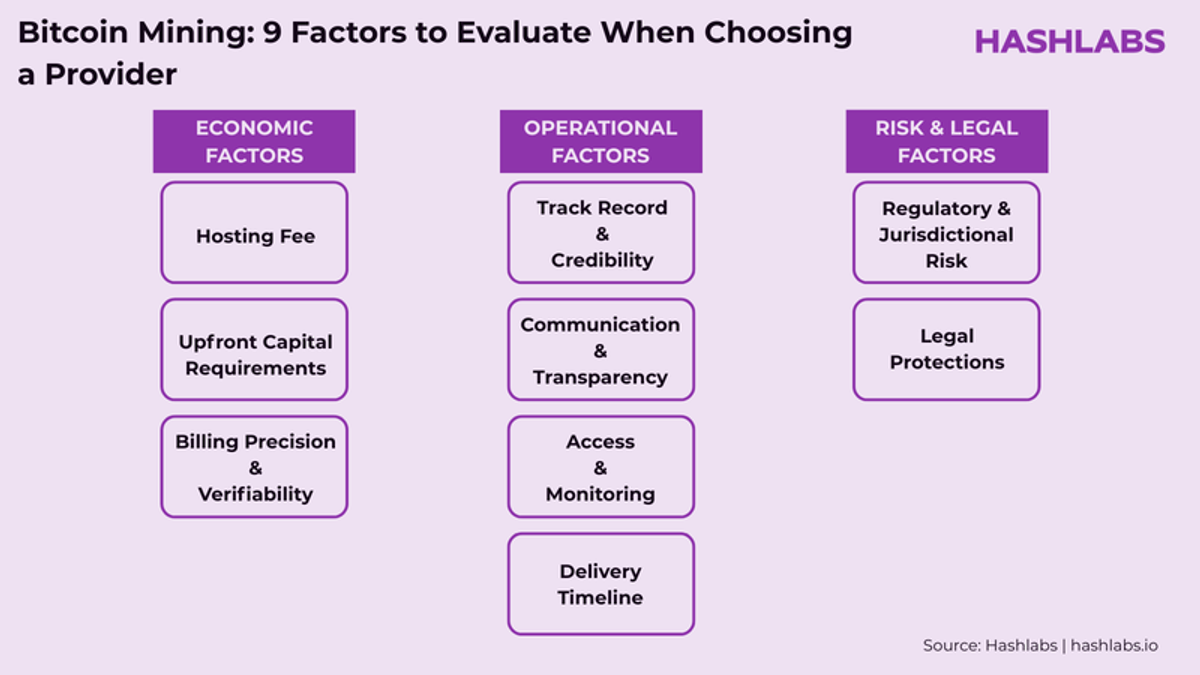
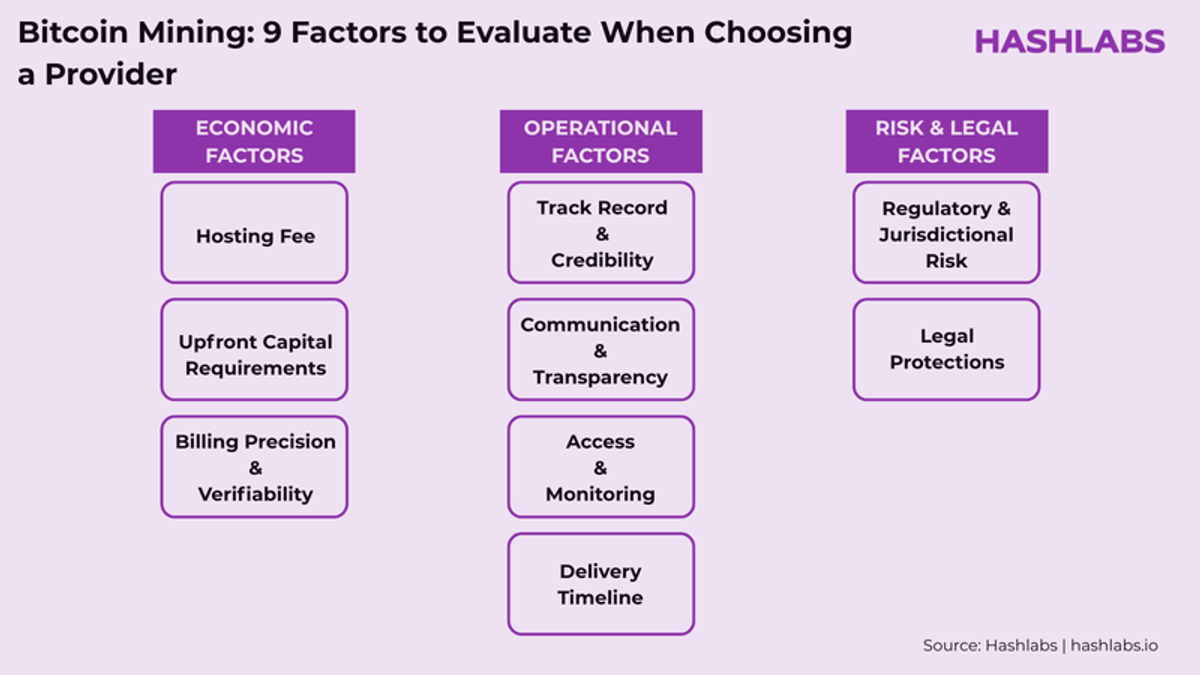
When choosing a Bitcoin mining hosting provider, track record and credibility matter more than the hosting fee — a cheap rate is worthless if the operator can't be trusted with your machines. Evaluate all nine factors, from pricing and billing transparency to communication and legal protections, before committing capital to any provider.
Choosing a hosting provider is one of the most important decisions you’ll make as a bitcoin miner. With machines worth hundreds of thousands — or even millions — at stake, a poor choice can lead to lost capital, hidden costs, or even outright fraud.
This article outlines the nine key factors to evaluate before committing to a hosting deal — from credibility and pricing to billing transparency, communication, and legal protections. Whether you’re new to hosting or scaling an existing operation, understanding these principles will help you protect your assets, avoid costly mistakes, and build long-term success.
Factor 1: Track Record and Credibility
You should under no circumstances make a hosting deal with an unreputable provider. You’re trusting this company with valuable equipment that can easily disappear if you choose the wrong counterparty. Some companies simply lack integrity — they’ll exploit clients through hidden fees, excuses, or outright dishonesty.
You must feel, deep down, that you can trust these people to safeguard your machines — and that trust should be grounded in both research and intuition.
How to Research
- Check reviews: Start with Google and Trustpilot. Positive reviews help, but dig deeper — some are fake or outdated.
- Look for third-party mentions: Are they cited in credible sources, client testimonials, or industry articles? A complete lack of visibility is a warning sign.
- Research the team: If no names are listed on their site, that’s a red flag. Verify the people’s background and online presence.
- Ask around: Talk to someone who’s worked with them before.
- Review their track record: Ask what they’ve built, for whom, and how they’ve handled challenges.
If, after all this, you still have a positive gut feeling about the company and the people behind it, you can check this box.
Track record and credibility are the most important factors in any hosting relationship. A reputable operator can handle volatility and setbacks; an unreliable one can destroy your investment — no matter how cheap the electricity looks.
Factor 2: Hosting Fee
A common mistake among newcomers is focusing almost entirely on the hosting fee. Price matters — but it’s far from the only factor. With experience, you realize reliability and professionalism often outweigh a small price difference.
That said, hosting rates are a core profitability driver. There’s no point investing if the price per kWh erodes your returns.
As a benchmark, hosting in the United States — the most stable market — averages around $0.075/kWh for small-scale clients. Rates outside the U.S. should generally be lower to reflect higher risk or cheaper power.
However, low rates can also be a pitfall. They may reflect inexperience, weak finances, or unsustainable pricing. Understand why a provider is cheaper before committing.
The rule is simple: avoid the highest rates, but don’t automatically chase the lowest. Look for a fair, sustainable price from a provider you trust.
Factor 3: Upfront Capital Requirements
Upfront capital requirements can have as much impact as the hosting rate itself. Typical requirements include:
- Deposit: Most providers charge one to two months of hosting fees to protect against non-payment. Anything beyond one month is unnecessary.
- Prepayment: Some bill after the month, others before. Paying after the month frees up capital, but the difference is minor.
- CAPEX: Larger projects may involve setup or infrastructure fees, often billed per MW. These should be viewed as prepaid hosting costs — and a lower ongoing rate should compensate.
A simple way to compare offers is to divide total CAPEX by the kWh you’ll consume over the contract term to find your effective rate.
As a rule of thumb: the higher the upfront cost, the lower the rate should be. Conversely, slightly higher rates can be justified if upfront requirements are low — but expect at least one month’s deposit in any case.
Factor 4: Billing Precision and Verifiability
This is one of the most overlooked aspects of hosting. You pay per kilowatt-hour consumed, but many providers don’t bill precisely based on actual usage.
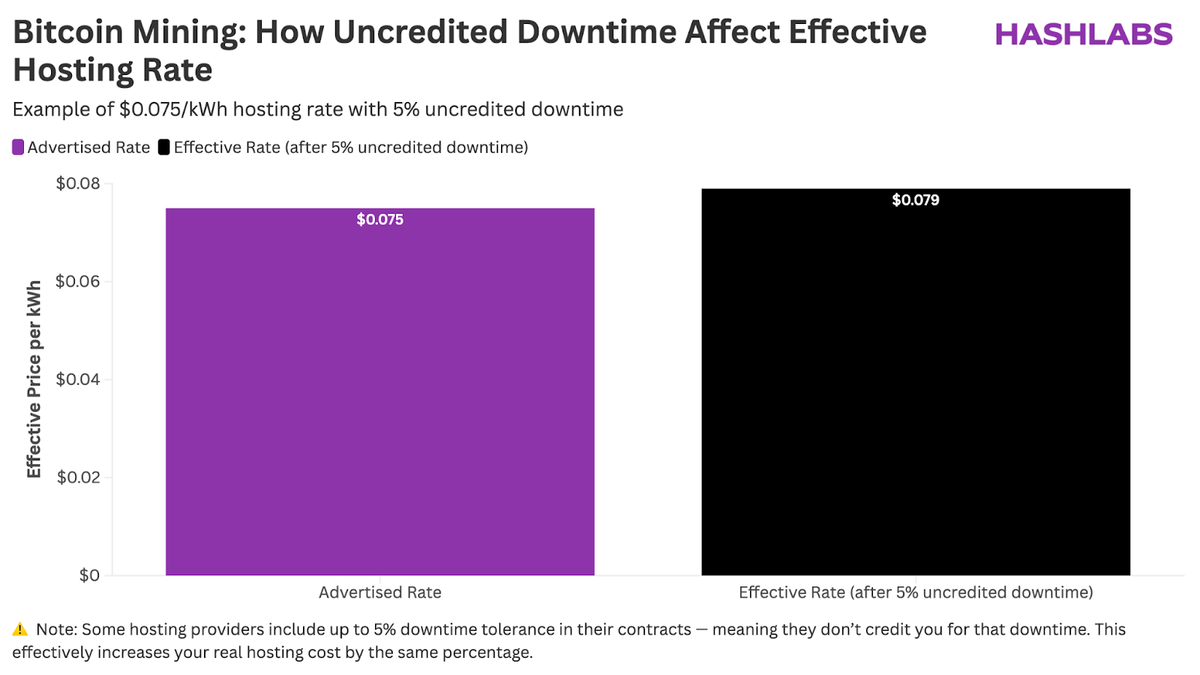
Some charge assuming 100% uptime and only credit partial downtime — effectively raising your cost. A 5% downtime tolerance, for instance, makes a $0.075/kWh deal cost closer to $0.079/kWh.
At Hashlabs, clients prepay assuming 100% uptime and are then credited for any shortfall — if uptime is 90%, clients receive a 10% refund. That’s the transparent way to operate.
Most sites include ancillary power (for cooling and lighting) in your bill, reflected by their power usage effectiveness (PUE). For example, a PUE of 1.03 means 3% additional consumption — fair, as long as it’s communicated clearly.
Finally, your hosting bills should always be verifiable. The provider should share the data behind your invoice. If not, that’s unprofessional — and a red flag.
Billing precision and verifiability are critical. Many investors lose money simply because they don’t check how their bills are calculated.
Factor 5: Communication and Transparency
In a perfect world, you’d never need to contact your hosting provider after signing. In reality, questions and issues will arise — and when they do, responsiveness and transparency are key.
A professional host should have a structured support system, ideally through a ticketing platform rather than direct chats. Private messaging may feel personal but doesn’t scale and often signals a small or immature operation.
Providers should reply within 24 hours at most, ideally sooner, and proactively communicate about events that affect uptime or billing. Before signing, ask about their support process, average response time, and how urgent cases are handled.
Remember — a hosting provider manages valuable assets on your behalf. You should always feel informed about what’s happening at their site. The best ones communicate early, clearly, and honestly — not only when asked.
Factor 6: Access and Monitoring
Access to your miners determines how much control and transparency you have — but it’s a balance.
Full VPN or SSH access is rare and usually impractical. If every client had that level of control, site operations would quickly become unstable.
The next best thing is access through the provider’s miner management software, letting you view hashrate and machine status safely.
Many professional providers offer a client dashboard showing uptime, energy use, and billing. Hashlabs, for example, provides the Hashlabs Client Portal to all clients for real-time monitoring.
Direct access matters more if you manage miners for others or run complex setups. For most investors, what counts is transparency and reliability — that your machines run, data is accurate, and communication is open when issues arise.
Factor 7: Delivery Timeline
Speed matters in mining. Every month your machines are offline is a month of missed revenue. Getting miners online quickly is critical for maximizing returns.
That said, delays are common — especially for larger deployments. Building infrastructure, setting up power connections, and importing equipment all take time.
Be wary of providers who claim there will be no delays. That’s unrealistic. Delays happen — the key is knowing whether your provider handles them transparently.
Ask:
- Have they faced delays before?
- How long were they?
- Does their timeline include a margin for error, or is it a best-case scenario?
A small delay won’t ruin your investment, but a major one can materially reduce returns. Choose a provider who plans realistically, not one who overpromises.
Factor 8: Regulatory and Jurisdictional Risk
This factor is often overestimated. Bitcoin mining is still a young, lightly regulated industry, and in many countries, even lawyers can’t fully define what’s legal or not. That uncertainty is part of the business.
You’re always taking some regulatory and jurisdictional risk — what matters is understanding it and ensuring your provider can manage it.
The bigger your operation, the more important this becomes. Large-scale investors should ensure compliance and assess the stability of local regulations.
It’s also worth remembering that lower hosting rates often reflect higher jurisdictional risk. The tradeoff is baked in. To achieve low costs, you often must accept some risk — just do so with a provider who understands the local environment and can handle it.
You can’t eliminate all risk, but you can decide which kind you’re comfortable taking — and who you trust to manage it.
Factor 9: Legal Protections
Legal protections come last because if you’ve chosen a reputable provider, you’ll likely never need them. Still, your contract should give reasonable protection through clear terms and an enforceable jurisdiction.
Contract enforcement can be expensive and slow, especially in developing countries. For small clients, the cost of legal action often outweighs the potential recovery. That’s why this factor ranks lower. For large, multi-megawatt investors, however, strong legal safeguards are essential.
When reviewing a contract, focus on the clauses that matter most, but recognize that many providers rely on standardized templates. Also, check the governing law — jurisdictions like the U.S., EU, or Singapore offer stronger protection. (Hashlabs uses Singapore law for this reason.)
Ultimately, legal protections are about limiting downside, not eliminating risk. The best defense is still working with a trustworthy provider so you never need to enforce anything in court.
Conclusion
Choosing a hosting provider is one of the most consequential decisions in Bitcoin mining. The cheapest rate or fastest promise rarely tells the whole story — what truly matters is reliability, transparency, and trust.
By carefully evaluating these nine factors, you can greatly reduce your risk and improve the long-term stability of your operation.