A Complete Framework for Evaluating Bitcoin Mining Investments
Profitable Bitcoin mining comes from disciplined, data-driven decisions, not hype. Evaluate every mining investment in four steps: learn the fundamentals that drive profitability, research the market and timing, analyze the numbers on the specific machines, and vet the hosting provider as rigorously as the hardware.

Bitcoin mining can be highly profitable — but only for those who make disciplined, data-driven decisions. Many miners rush into buying machines based on hype or sales pitches instead of proper analysis.
To help miners make smarter decisions, we’ve developed a simple four-step educational framework that ties together everything you need to know — from understanding the basics to choosing the right hosting provider.
Disclaimer: This article is for informational and educational purposes only and does not constitute financial, investment, or tax advice. Bitcoin mining involves substantial risk, and readers should conduct their own research or consult qualified professionals before making investment decisions.
Step 1: Learn the Fundamentals
Before investing, take the time to understand what drives mining profitability — bitcoin price, network difficulty, machine efficiency, and electricity cost — as well as the main risks, such as market volatility, downtime, or simply getting rug pulled by a bad hosting provider.
Start by reading the educational resources on the Hashlabs Insights page. The time spent learning the basics will save you from costly mistakes and poor decisions.

As good old Warren Buffett says, every investor should stay within their circle of competence. If mining isn’t yet part of yours, study the industry before committing large amounts of capital. Of course, starting small can be smart — you’ll learn much faster once you have some skin in the game. But don’t bet your house on something you don’t yet fully understand.
Step 2: Research the Market and Identify Opportunities
Once you understand the fundamentals, study the market and timing.
Bitcoin mining is a hyper cyclical industry — profits and machine prices surge in bull markets and compress in bear markets. The best opportunities often come when nobody is talking about mining. As Buffett famously said, “Be fearful when others are greedy, and greedy when others are fearful.”

That means buying machines when sentiment is negative and prices are low, not when everyone else is piling in during a bull run. Occasionally, it can still make sense to buy during bullish periods if machine prices lag behind bitcoin’s price rise — but in general, superior returns come from being early, not from following the crowd.
When researching opportunities:
- Monitor bitcoin price, network hashrate, and machine price trends. Look for price dislocations — when machine prices haven’t yet adjusted to bitcoin’s movements.
- Get a sense of the overall “frothiness” of the market. That is, how much hype there is in the market. The less, the better.
- Study hosting markets for low-cost, reliable energy and stable jurisdictions.
This part of the framework is also the most difficult. Understanding the true state of the market requires experience — it’s more of an art than a science. That’s why we’re not prescribing any specific tools or models here. Instead, learn to develop your own judgment over time. Trust your intuition — and as a general rule of thumb, if nobody else is looking to invest in mining, that might be the right time to start.
Step 3: Analyze the Numbers Using the Only Two Metrics That Matter
Once you find a potential acquisition or hosting deal, evaluate it using just two metrics — and ignore everything else.
- Payback Period – How long it takes to recover your investment.
- Cost-to-Revenue Ratio – How much of your revenue goes toward operating costs. Read our guide here.
Use the payback period to measure how quickly you’ll recoup your investment — it’s your pure return metric. Then, supplement it with the cost-to-revenue ratio, which shows how much profit margin your machines are generating. This second metric reveals how close you are to becoming cash flow negative — in other words, how far you are from being forced to turn your machines off.
These two numbers tell you all you need to know about profitability and risk.
Step 4: Evaluate the Hosting Provider
Even the best numbers can collapse if your hosting provider underperforms. Uptime, transparency, and integrity determine whether your mining operation succeeds.
Use our guide — 9 Factors to Evaluate When Choosing a Provider — to assess partners carefully.
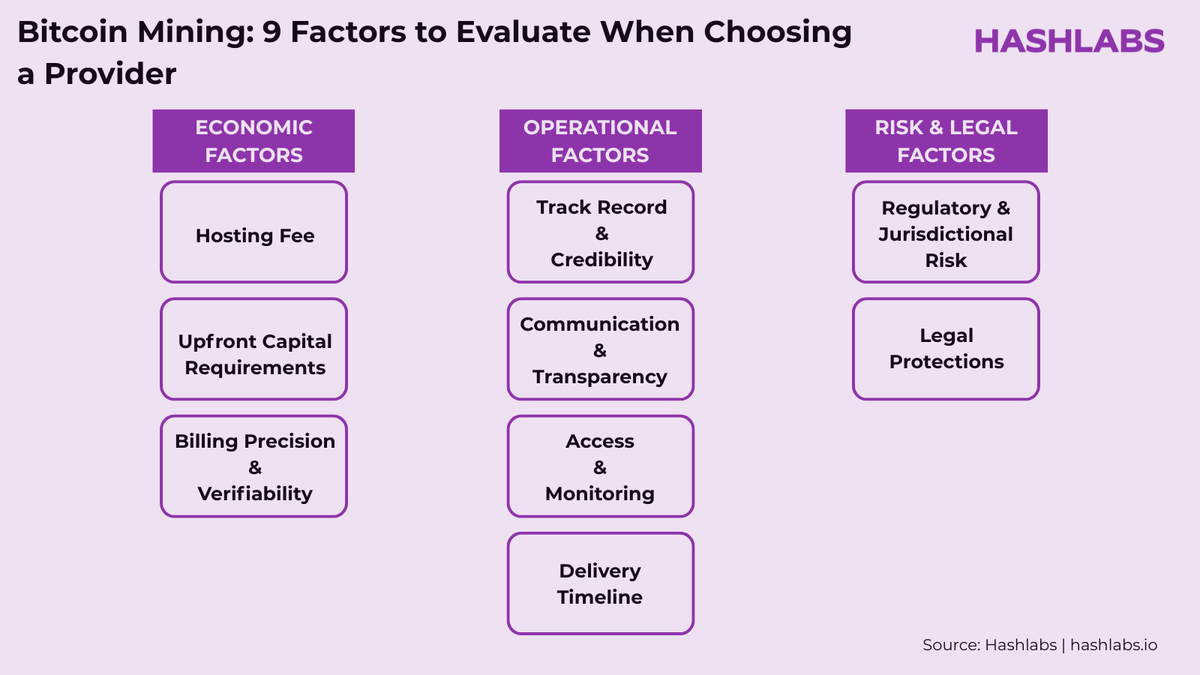
Conclusion: Learn, Analyze, and Execute
Profitable bitcoin mining requires process and discipline, not luck or marketing hype.
Follow these four steps to make smarter, data-driven decisions:
- Learn the Fundamentals – Build your knowledge and stay within your circle of competence.
- Research the Market – Time your entry and buy when others are fearful.
- Analyze the Numbers – Focus only on payback period and cost-to-revenue ratio.
- Choose the Right Partner – Ensure flawless execution through a reliable host.