Report
&
March 9, 2026

Bitcoin mining is the only form of mining that truly matters. Every year, we see waves of hype around new proof-of-work coins — promising “better technology,” “fairer distribution,” or “higher efficiency.”
Yet, without fail, these coins collapse, leaving behind nothing but obsolete machines and disappointed miners.
The reality is simple: Bitcoin has completely won the proof-of-work game.
In the latest market crash on October 10th, bitcoin once again proved its strength, while every other mineable coin showed its fragility. Today, bitcoin represents 97.2% of the entire proof-of-work market cap, and its dominance keeps increasing.
For anyone serious about mining as a business — not gambling — it’s time to stop chasing noise and focus on the one asset that actually matters.
Here are five reasons why bitcoin is the only coin worth mining.
The latest market crash on October 10th was a brutal stress test for all proof-of-work coins. The results were crystal clear.
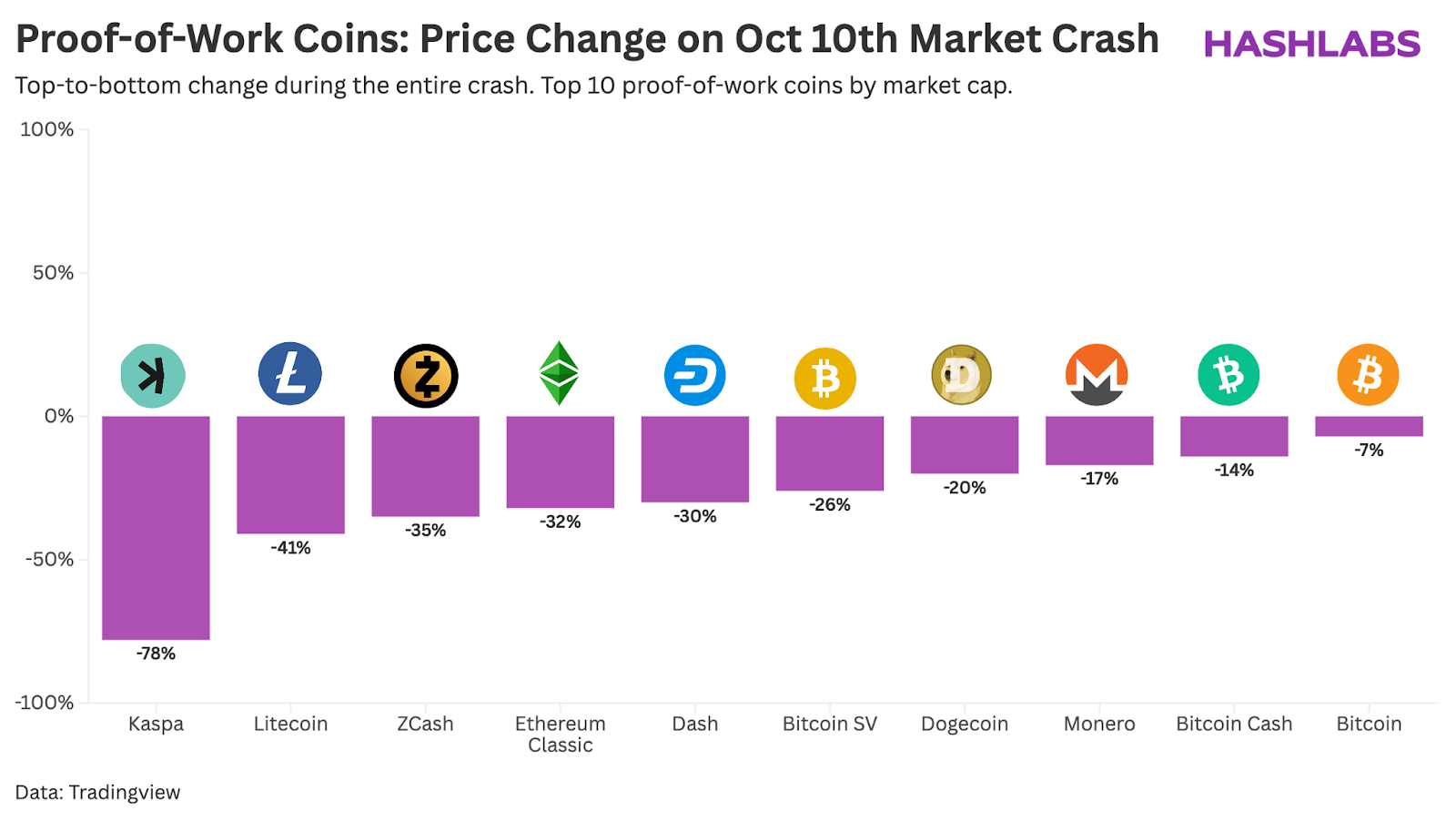
While Bitcoin dropped only 7% top-to-bottom, many of the alternative proof-of-work coins collapsed catastrophically. Kaspa, for example, fell by 78% in a matter of hours. Litecoin, one of the favorites among altcoin miners, fell by a staggering 41%.
This shows that there is no real liquidity in these coins — their prices are easily manipulated. It’s dangerous to buy mining machines whose entire value depends on coins that can move 40–80% in a day due to a few large holders selling or coordinated manipulation.
Bitcoin, on the other hand, has become a globally traded, highly liquid asset. It is owned by institutions, sovereign entities, and millions of individuals worldwide. Its price is not easily swayed by a few actors. You can be confident that your investment in bitcoin mining is tied to something real — a digital asset with deep markets and genuine demand.
As of today, Bitcoin represents 97.2% of the entire proof-of-work market capitalization. All other mineable coins combined make up less than 3%.
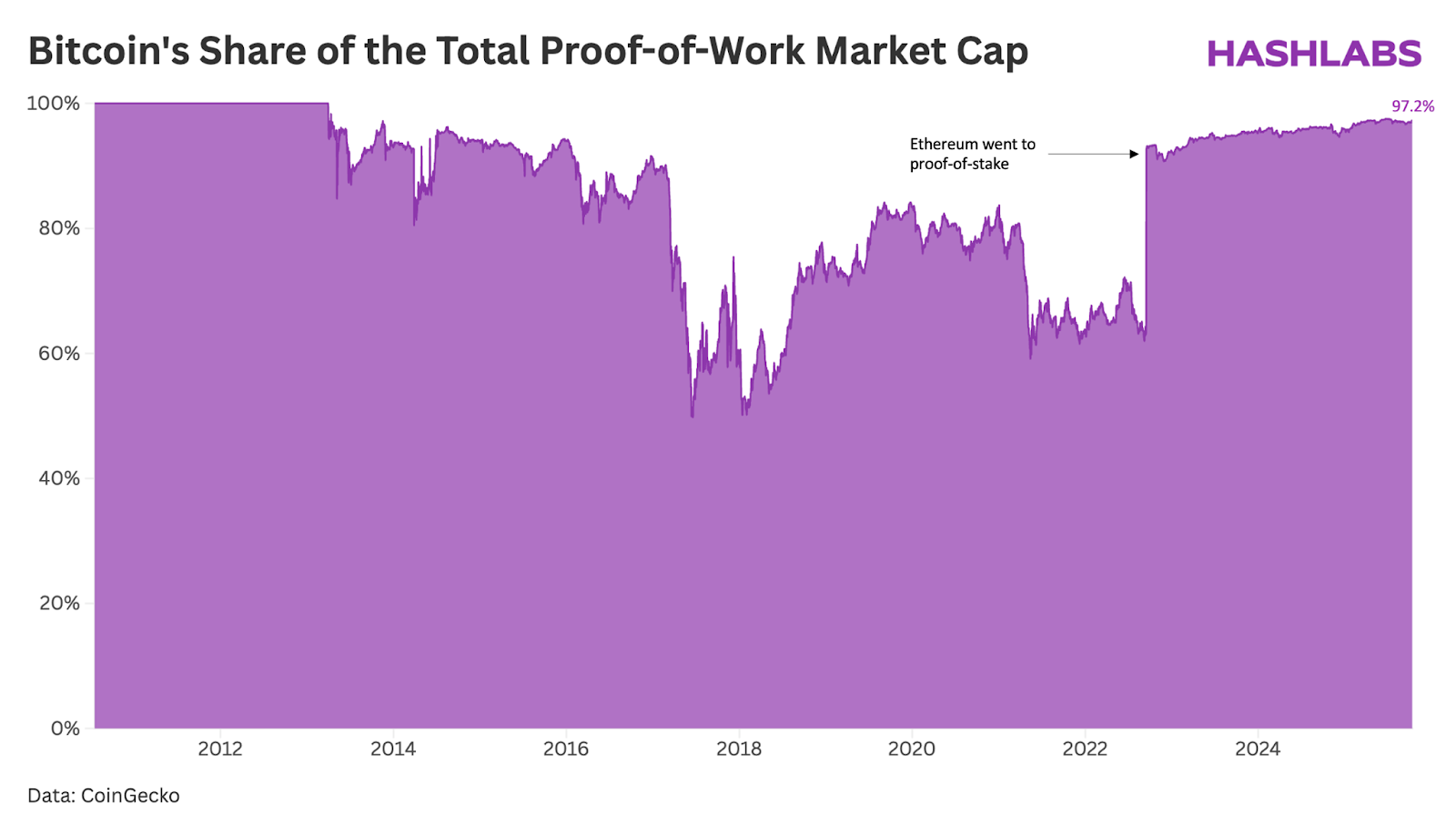
That means all the noise around alternative PoW coins — Kaspa, Alephium, Litecoin, etc. — represents only a rounding error next to bitcoin.
Mining is already a complex and capital-intensive business. Bringing in dozens of micro-cap coins with zero real liquidity only adds chaos and risk. Do you really need that in your life?
The long-term trend is clear: Bitcoin’s dominance is growing.
After Ethereum moved to Proof-of-Stake in 2022, Bitcoin’s share of the PoW market surged past 90%, and today it stands at 97.2%. Every year, Bitcoin’s share rises while the rest of the PoW coins stagnate or shrink.
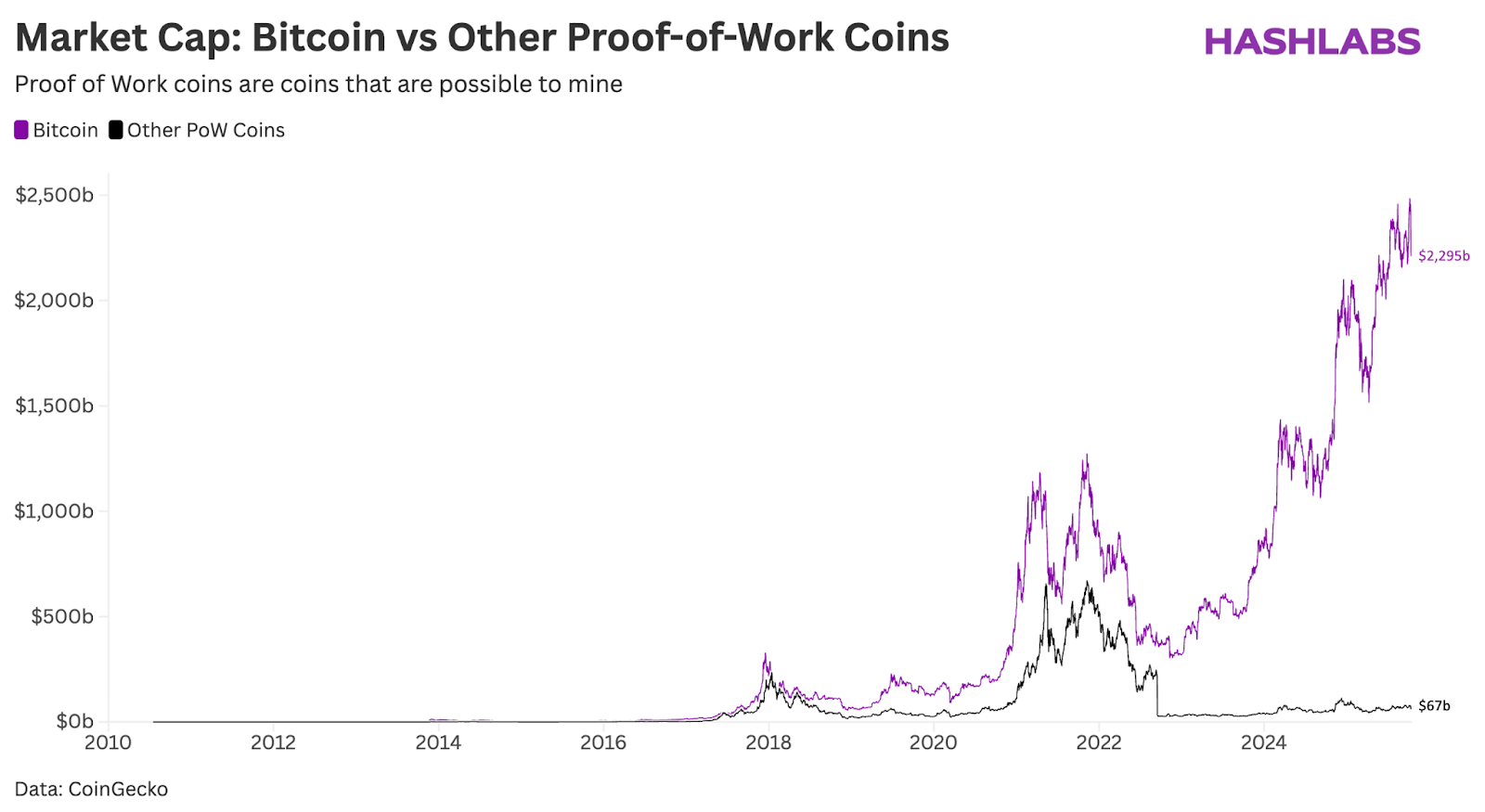
Many of these alternative coins also suffer from significant inflation — insiders, developers, and early investors continuously increase the supply to dump on new miners and speculators. So even if there’s temporary demand, the supply inflates faster.
It’s like holding fiat — except worse, because it’s backed by nothing but hype and uncertainty.
Bitcoin is fundamentally different. It is not a copycat or a speculative experiment — it is the only decentralized, censorship-resistant, truly global monetary network.
Its mining ecosystem is mature, transparent, and globally distributed. It has robust financial infrastructure — futures, ETFs, derivatives, custody, and real demand from both institutions and individuals.
Other proof-of-work coins don’t come close. They are mostly developer-driven pump-and-dump schemes that use miners as exit liquidity. It’s no surprise that many of these coins are heavily promoted by ASIC manufacturers themselves, who need new narratives to sell more machines.
Other coins come and go — bitcoin stays.
Since Ethereum’s transition to Proof-of-Stake, bitcoin has completely dominated the mining landscape. It has the liquidity, the fundamentals, and the resilience that make mining a serious long-term business.
Everything else is just noise.
If you’re serious about mining — only mine bitcoin.
Subscribe to the Hashlabs newsletter for weekly insights on Bitcoin mining trends, data, and market analysis from the Hashlabs team.